A streaming platform offers you a single format: the track. YouTube accepts half a dozen, decides to bring you viewers without you going out to find them, and leaves you complete editorial control. It is probably the promotional tool independent musicians underuse most — and it is free.
The freedom streaming platforms don’t give you
On a music platform, the unit of publication is the song. You choose neither the presentation, nor the context, nor the publishing rhythm; you feed a catalogue.
A video channel works the other way round: you are the director of your own programme. You decide what you publish, in what order, in what form, and you can shift the editorial line as you go. That editorial freedom is the tool’s real value — long before the statistics.
It has a practical consequence: you can pair your music with images, which multiplies the possible viewpoints on a single song. A track then exists in a studio version, a live version, a rehearsal version, an explained version. Four objects, one composition.
Six formats, six audiences
Each format catches a slightly different audience, and that is exactly why you shouldn’t stop at the music video.
- The music video catches people looking for a track. It is the most expensive format and the least differentiating.
- Live and concert footage catches people who want to check it stands up. It is the most convincing format for a promoter.
- The rehearsal catches musicians. Unbeatable effort-to-result ratio: one fixed camera, good sound, one take.
- The studio session catches people curious about how things are made. It tells the work, not the result.
- The interview catches people interested in the person. It establishes a voice, literally.
- The making-of catches people who love backstage, and gives value to footage you have already shot.
Sound before picture
This is the most useful advice you can give a musician who films: your audience will forgive you an average picture, never mediocre sound. One decent fixed camera with carefully recorded sound is infinitely more effective than three camera angles running on the camera’s own microphone. You already own the gear you need — use it.
How people find you
The second argument is mechanical: the platform brings you viewers without you having to go and find them. Video suggestions, playlists and the search engine do that work — provided you have done yours.
Concretely that means three things, in this order of importance:
- A title that describes what people will see. « Song name — live session, [city], 2026 » beats the song name on its own.
- A description you actually wrote. Two or three sentences on what this video is, who plays, where, with what. That text is what lets the platform understand your content.
- Thematic playlists. They chain your videos together, which mechanically increases the time spent on your channel.
The reflex to lose: aiming at subscriber count. The useful indicator is the number of videos that produce a first contact — then the proportion of people who watch a second.
Starting without losing your weeks to it
A channel dies of ambition, rarely of a lack of means. Three rules to keep going:
- One format to begin with. The one you can produce with no logistics — for most musicians, the filmed rehearsal.
- A rhythm you will hold for a year. One video a month published for twelve months is worth infinitely more than six videos in three weeks and then nothing.
- Recycle. A reinterpretation of an older track is a video in its own right, and it requires no new writing.
What the video covers
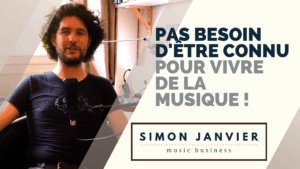
The video above — in French — cheerfully states the obvious, since it addresses people watching it on the very platform it is about. I stress the freedom of format, far greater than on music streaming services, the range of possible programmes (live, streams, rehearsals, studio sessions, interviews), and the fact that how your videos are indexed — titles and descriptions included — determines whether your fans can find you at all.
Frequently asked questions
- Should I keep a channel separate from my artist profile?
- No, in the vast majority of cases: splitting the audience across two channels divides the signal and gains nothing. Playlists are enough to organise content of different kinds.
- How long before it produces anything?
- Longer than you hope, and irregularly: a video posted two years ago can start circulating without warning. That is why regularity beats intensity.
- Do I really have to show backstage?
- It is not compulsory, and some aesthetics sit badly with it. But it is the kind of content that costs least to produce and creates the most attachment, because it shows real work.
- What about monetisation?
- Treat it as a bonus, not a goal. For a musician the platform’s value is promotional: it brings people towards your music, your gigs and your collaborations — see offer your services to get known.
Going further
- Rework your own back catalogue — material for a channel without writing anything new.
- Offer your services — the other way to borrow an audience.
- Music business: where to start — the distribution question as a whole.