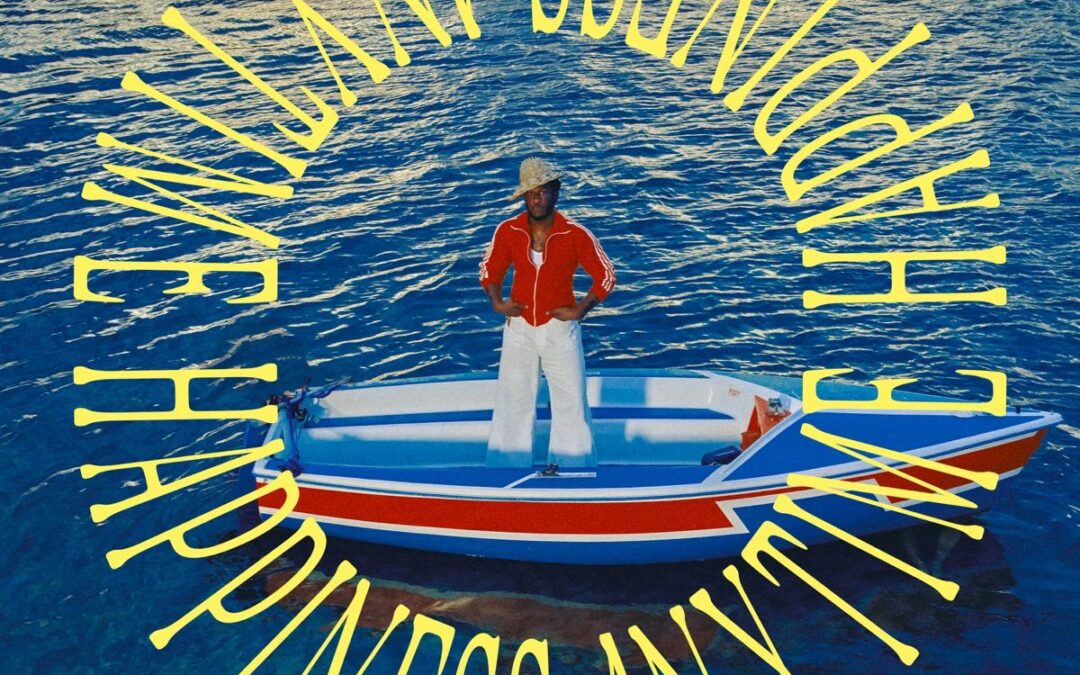
Pochette officielle — Columbia Records
Leon Bridges released his fifth studio album, “Happiness Anytime,” last Friday via Columbia Records. Bridges broke through in 2015 on a wave of retro neo-soul nostalgia that cast him as a modern Sam Cooke in a three-piece suit. A decade later, he’s making a deliberate pivot: production duties on the new record go entirely to Josh Lloyd-Watson and Lydia Kitto, two-thirds of British electro-funk outfit Jungle. The result plays less like a classic soul singer’s record than a sustained invitation to move.
From retro crooner to dance floor
When he emerged with “Coming Home” in 2015, Leon Bridges was instantly compared to Sam Cooke: three-piece suits, a smooth voice, arrangements that sounded lifted straight from a 1960s Motown session. The record’s success helped cement him as a figurehead of the vintage-soul revival alongside artists like Michael Kiwanuka. His next two albums, “Good Thing” and “Gold-Diggers Sound,” had already eased him toward a warmer, more contemporary strain of R&B. “Happiness Anytime” takes that shift much further, swapping out his entire production team rather than simply adjusting the dials.
Tapping Jungle is a telling choice: the London duo has built its name on warm, horn-and-choir-driven club anthems that never quite go cold, even at full throttle. For Bridges, borrowing that club vocabulary while trying to hold on to the human warmth that’s always been his signature is a real gamble for an artist whose image has leaned on intimacy and restraint rather than dance-floor exuberance.
It’s worth remembering how unusual that pairing looks on paper. Jungle made its name scoring festival main stages with disco-inflected falsetto hooks and tightly choreographed visuals, a world away from the hushed, church-adjacent intimacy of Bridges’ catalog. Rather than simply guesting on a couple of tracks, the London pair produced the record top to bottom, which explains why “Happiness Anytime” sounds less like a soul album with dance flourishes bolted on and more like a dance record that happens to be sung by one of the best voices in contemporary soul.
A three-part rollout all summer
The album didn’t arrive out of nowhere. Starting in July, Bridges rolled it out in stages, releasing two mini-EPs, “Happiness Anytime: Part 1” and “Part 2,” ahead of the full-length. Songs like “Talk It Over” and “Tears of Joy” had already been circulating all summer, establishing the record’s dance-forward identity well before its official release. That staggered strategy, increasingly common among established artists, lets a team gauge audience reaction before the full album lands while keeping attention alive over several months.
A mixed reception
Early reviews have largely praised the record’s generosity: a joyous, dance-driven soul album carried by a still-immaculate voice. Others, though, feel the soulfulness and sharp songwriting that once set Bridges apart get pushed to the background behind the groove’s machinery, with longer, more repetitive sequences built more for a dance floor than for close, headphone-focused listening.
The gamble fits a broader pattern seen this year among American soul and R&B artists reaching toward afrobeat and Latin American rhythm for new ways to move a room without abandoning their roots. With “Happiness Anytime,” Leon Bridges is willing to trade a bit of his crooner gravitas for energy, even if it risks splitting part of his longtime audience.
What ultimately makes the record interesting isn’t whether the gamble fully pays off, but the fact that Bridges chose to take it at all at this stage of his career. A decade in, with a Grammy and a stable audience already secured, he had every incentive to keep refining the same lane that made him a star. Instead, “Happiness Anytime” reads as a statement that vintage-soul revivalism was a starting point rather than a destination, and that the artist behind it is still actively looking for rooms he hasn’t played in yet.