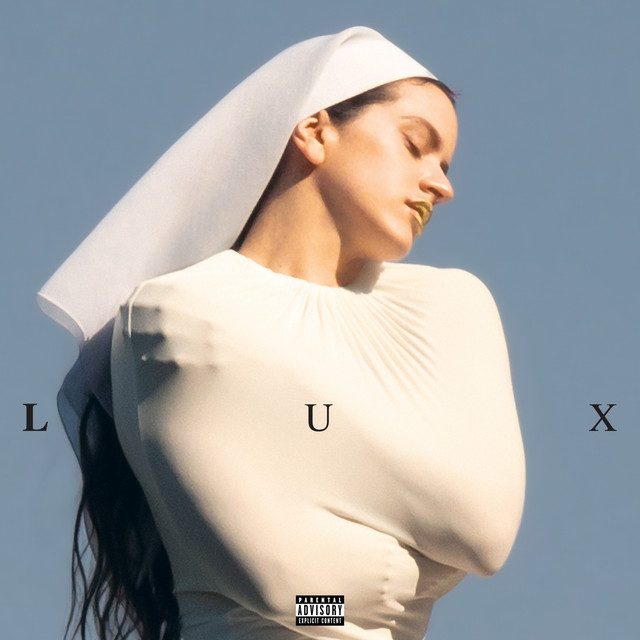
Pochette officielle — Columbia Records
Six months, seventeen countries and some forty sold-out arenas later, it all comes down to one night. On September 3, 2026, Rosalía closes her LUX tour at the Coliseo de Puerto Rico in San Juan — a finale staged as a homecoming of sorts, on an island that bridges the United States and Latin America, and the last page of the most audacious chapter of the Catalan singer’s career.
An album recorded with a symphony orchestra
To grasp the scale of the tour, you have to go back to its source. Released on November 7, 2025 via Columbia Records, LUX is Rosalía’s fourth album and easily her boldest. After the glitchy electronics and futuristic reggaeton of Motomami, she chose to record the whole thing with the London Symphony Orchestra, conducted by Iceland’s Daníel Bjarnason. Strings, brass, choirs: the record embraces an almost classical ambition where the industry expected another club record.
It was far from a safe bet. Trading samples and distorted bass for a full symphonic ensemble meant risking the very audience that had followed her onto Motomami. Rosalía did the opposite — she widened her reach precisely by refusing to repeat herself, and turned a supposedly niche gesture into one of the year’s defining pop statements.
Fourteen languages, four movements
LUX is built like a nested work. Its eighteen tracks are arranged into four movements, symphony-style, and sung in fourteen different languages — from Spanish and Catalan to Arabic, French, German, Hebrew, Italian, Japanese, Latin, Mandarin, Portuguese, Sicilian and Ukrainian. A dizzying linguistic sweep that circles a single idea: transformation, the record’s beating heart. Few mainstream albums treat their listeners as capable of following a work this dense from start to finish.
She did not go it alone. The opening single, “Berghain,” pairs her with two heavyweight guests, Iceland’s Björk and America’s Yves Tumor. Elsewhere the album makes room for the Mexican-American group Yahritza y su Esencia on “La Perla,” Portuguese fado singer Carminho, and the flamenco voices of Estrella Morente and Sílvia Pérez Cruz — a cast that says everything about the intent: to let traditions converse rather than rank them.

Numbers and critics in tune
Few albums this demanding meet with such success. On release day, LUX drew 42.1 million Spotify streams, a record for a Spanish-speaking female artist. It went on to debut at number four on the Billboard 200, number one in Spain, number two in France and Germany. Critics called it one of the peaks of 2025, almost unanimously praising the coherence of a project many had written off as a gamble on paper.
Three singles paced the climb: “Berghain” on October 27, 2025, “La Perla” in early December, then “Sauvignon Blanc” in February 2026 — so many windows onto an album that shuns the easy hit and rewards a full listen. Each arrived with its own visual world, extending the record rather than merely advertising it.
A tour staged as a ritual
On stage, LUX took on an extra dimension. Launched on March 16, 2026 in Lyon, the tour crossed Europe, South America and then North America with a stripped-back, almost liturgical staging in which voice and orchestra outrank spectacle. By ending the run in Puerto Rico, Rosalía echoes a gesture that has become common among the great figures of Spanish-language music: Bad Bunny closed his own record-breaking tour on the island just weeks earlier.

What could possibly follow a record this total is anyone’s guess. Rosalía has trained her audience never to expect the same road twice. For now, she closes LUX at the summit — leaving behind one of the most ambitious projects a pop artist has dared to carry to this level of acclaim.