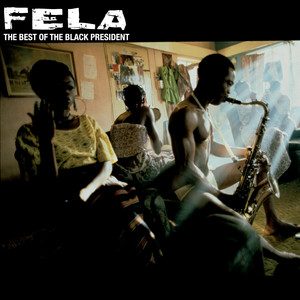
Pochette — « Zombie », Fela Kuti & Africa 70
Fela Kuti didn’t just invent an entire genre with his Africa 70 and later Egypt 80 bands: Afrobeat. He turned every record into a political statement, often aimed squarely at the military regimes that ruled Nigeria through the 1970s and ’80s. Built on sprawling tracks where the groove patiently builds tension before the lyrics arrive to justify it, his music still runs through much of contemporary African and Western music today. Here are ten songs to trace that journey, from the early provocations of the early 1970s to the last releases of his career.
Long before the word “Afrobeat” meant anything outside West Africa, Fela was already fusing highlife, jazz and funk into something built to run for ten or twenty minutes at a time, giving every idea room to breathe before the horns and the message both land at full force.
Laying Afrobeat’s foundations (1971-1977)
“Lady”
Recorded in 1972 with the Africa 70 band, “Lady” is one of the first tracks where Fela Kuti openly laid out his views on relationships and the role of women in Nigerian society. The song contrasts the Western “lady,” who demands overt equality, with the African woman as he saw her at the time, bound more closely to tradition. The lyrics have since been widely debated, but the track remains one of the foundational statements of his social commentary, riding a groove that was already devastatingly effective, all brass stabs and electric organ.
“Water No Get Enemy”
Released in 1975 on the album “Expensive Shit,” this is arguably the most universal song in his entire catalogue. By comparing his own resilience to water, which has “no enemy” because no one can do without it, Fela delivers a crystal-clear metaphor for his ability to survive repression. The horn riff, one of Afrobeat’s most recognisable, has since been sampled and covered by generations of musicians far beyond Nigeria.
“Expensive Shit”
The title track of his 1975 album recounts, with unmistakable dark humour, a real incident: during a raid, Nigerian police forced Fela to swallow a joint to frame him for marijuana possession, then retrieved his stool hoping to find evidence. The song turns that humiliation into a triumphant retort, riding a hypnotic near-thirteen-minute groove that never lets the tension go.
“Colonial Mentality”
On this 1977 track, Fela takes direct aim at the cultural legacy left by British colonisation in Nigeria: the way people dressed, spoke and thought, modelled on the West rather than owned from African roots. The song remains a key text for understanding the pan-Africanist ambition behind his work, one that never separated the music from the politics it was built to carry.
Music as a political weapon (1976-1986)
“Zombie”
Released in 1976, “Zombie” is the song that turned Fela Kuti’s relationship with Nigeria’s military government into open warfare. By comparing soldiers to mindless zombies blindly following orders, the track became an instant popular anthem, sung across the country despite being banned from the airwaves. The regime’s response was brutally direct: months later, the army set fire to the Kalakuta Republic, the commune Fela had founded, in a raid that killed his mother.
“Sorrow, Tears and Blood”
Written as a direct response to the Kalakuta Republic attack in 1977, this track describes, with almost clinical coldness, the mechanics of repression: the fear that sets in, then the silence that follows the violence. It is one of the darkest entries in his catalogue, where Afrobeat’s usual dancefloor energy is entirely repurposed to serve testimony and mourning.
“International Thief Thief (I.T.T.)”
Released in 1979, this sprawling, roughly twenty-minute track takes direct aim at Western multinationals and their complicity with Nigerian elites, embodied through the acronym I.T.T. (International Telephone and Telegraph). It’s a perfect example of how Fela built his compositions as long-form arguments, letting the instrumental patiently build tension before the lyrics arrive to justify it.
“Shuffering and Shmiling”
On this 1977 track, Fela targets both religious authorities and the resignation he saw in the Nigerian population, urged to “suffer and smile” rather than rise up. The title, which deliberately blends English and Nigerian pidgin, went on to enter everyday language across West Africa, well beyond music fans.
“Teacher Don’t Teach Me Nonsense”
Released in 1986, this late-career track proves Fela never softened his confrontational tone, even after a decade of state repression and several stints in prison. Targeting the hypocrisy of Nigeria’s leadership at the time, it shows an artist still razor-sharp as a writer, backed by a smaller but no less precise band than the one that carried his great 1970s records.
“Gentleman”
On this 1973 track, Fela mocks Africans who insist on wearing suits and ties under the equatorial sun rather than embracing clothing suited to their climate, echoing the theme of “Colonial Mentality.” One of the most accessible tracks in his 1970s catalogue, it’s often cited as an ideal entry point into his world for anyone discovering Afrobeat for the first time.
A legacy that keeps growing
Fela Kuti died in 1997, but his influence has only grown since. His sons Femi and Seun Kuti keep Afrobeat alive on stage, the musical “Fela!” introduced his story to Broadway audiences, and his catalogue keeps getting sampled by hip-hop, electronic and afrobeats artists around the world. The horns of “Water No Get Enemy” or “Zombie” are as familiar to African audiences today as to Western ones, proof that music built to call out one specific regime ended up becoming a universal language.
Revisiting these ten songs also explains why Afrobeat, nearly thirty years after its inventor’s death, remains one of the most cited musical grammars for artists trying to make people dance while telling them something bigger than just a song.
What still sets Fela apart from most of the artists who later borrowed his sound is the sheer discipline behind the chaos: every one of these tracks was rehearsed for months with a band of a dozen musicians or more before it ever reached a stage or a studio, and the political message was never allowed to blunt the groove, or the other way around.