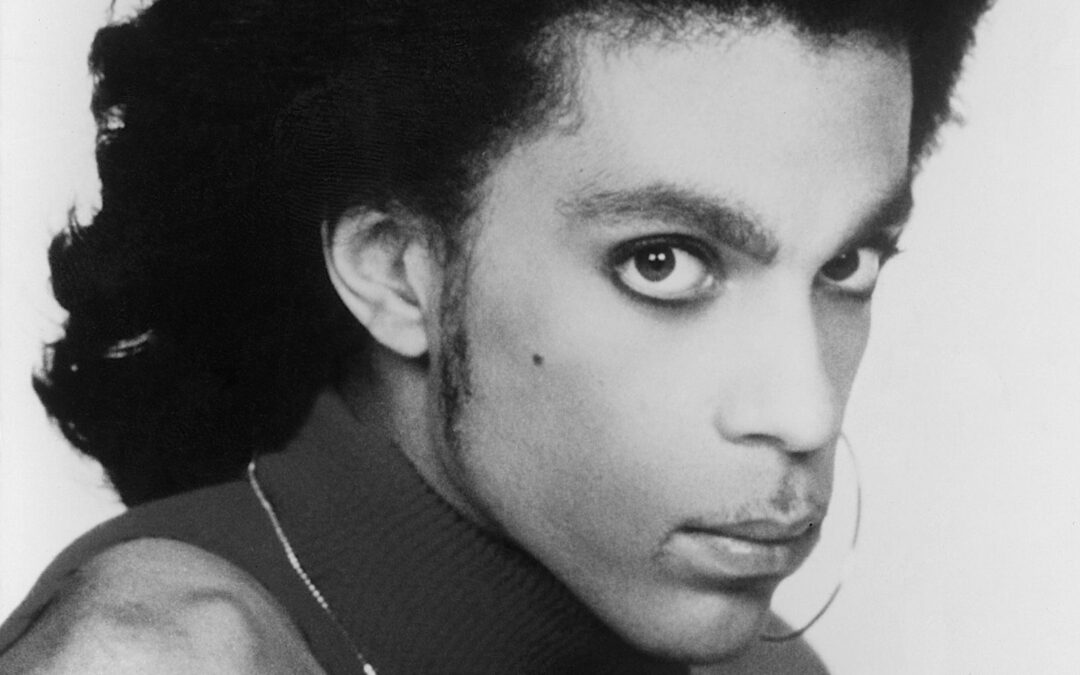
Prince — photo promotionnelle, image d'archive
Few artists have blurred the lines between pop, funk, rock and soul as thoroughly as Prince. Across four decades, from his beginnings in Minneapolis to his death in 2016, he wrote, arranged and often played nearly every instrument on his own records, leaving behind a catalogue so vast that his archives are still turning up unreleased material today. Ten songs obviously cannot exhaust that richness, but they can trace the major chapters of a body of work that always moved faster than its era.
The Minneapolis beginnings (1982-1983)
At the turn of the 1980s, Prince and his musicians invented what would soon be called the “Minneapolis sound”: a fusion of funk, electronic pop and rock, carried by the Linn LM-1 drum machine rather than a traditional rhythm section. The first two songs on this list come from that founding period.
1999
The title track of his 1982 album, “1999” announces from its first bars what the decade ahead would sound like for Prince: an ever-present Linn LM-1 drum machine, a high-pitched vocal, and lyrics that mix party energy with end-of-the-world dread. Fairly modest on release, the song went on to become one of his most replayed anthems, especially as the real year 2000 approached.
Little Red Corvette
Written after Prince fell asleep in keyboardist Lisa Coleman’s Camaro and dreamed of a red Corvette, the song became his first major US hit. It already carries the signature mix that would define him: dry electronic rhythm, an immediately catchy pop melody, and lyrics working on two levels at once, the car and the innuendo.
The “Purple Rain” peak (1984-1986)
The film and album “Purple Rain” turned Prince into a global superstar in 1984. It is also when he sharpened his pop melodic sense the most, without ever giving up the rawness of his funk.
When Doves Cry
Prince played every instrument himself, then made the radical choice to strip the bassline out of the final mix. That absence, unusual for a radio single, gives the track its distinctive tension and helped make it his first number one in the US, pulled from the soundtrack to the film “Purple Rain.”
Purple Rain
An eight-minute-plus ballad built around one of the most discussed guitar solos in rock history, “Purple Rain” tells a story of heartbreak and redemption that outgrew its own film. It remains the song Prince most often chose to close his concerts with.
I Would Die 4 U
The third single off “Purple Rain” already hints at the more electronic, more funk-driven turn Prince would take in the following years. It became one of the most sampled songs in his catalogue, proof of how far ahead of its time the writing was.
Kiss
Originally written for a band signed to his own label, “Kiss” was reclaimed by Prince, who stripped it down to almost nothing: barely any bass, a minimal groove, and a now-iconic falsetto. The gamble paid off, and the song climbed to number one on the US charts.
Raspberry Beret
Taken from 1985’s “Around the World in a Day,” this psychedelic-tinged song tells of a chance romance in a shop with a made-up name. It shows Prince’s ability to slide, from one album to the next, from the carnal pop of “Purple Rain” toward more baroque territory, inherited from his admiration for the Beatles.
Maturity and reinvention (1987-1994)
In the second half of the 1980s, Prince grew more political and more experimental, before returning, in the early 1990s, to a more carnal funk carried by his new band, the New Power Generation. The last three songs on this list tell the story of that decade of constant change.
Sign O’ The Times
Over a minimalist beat, Prince tackles crack, AIDS, poverty and the arms race head-on, a sharp turn from the festive image attached to him until then. The song, and the album that carries its name, mark one of the critical peaks of his career, proof an artist could carry real social issues to the top of the charts.
Cream
With the New Power Generation, Prince returned in 1991 to a more direct, more sexual funk rock, carried by a deliberately simple guitar riff he said he wrote while looking at himself in a mirror. The song became his last number one in the US as a performer.
The Most Beautiful Girl in the World
Released in 1994 while Prince was locked in a dispute with his record label and had started going by an unpronounceable symbol, this song nonetheless returns to the simplicity and direct emotion of his biggest singles. It became a worldwide hit, proof his gift for an unstoppable melody never left him, even at the most turbulent point of his career.
A legacy that is still very much alive
From Beyoncé to Bruno Mars, and across a whole generation of contemporary R&B and funk artists, few musicians fail to cite Prince as an absolute reference point. His perfectionism in the studio, his insistence on controlling his own masters, and his ability to change styles without ever losing his identity continue to inspire musicians far beyond the funk and soul scene he came from.
What stands out, listening back to these ten songs in a row, is the speed at which Prince moved through aesthetics that most artists spend an entire career exploring just once. In barely a decade, he went from the cold drum machine of “1999” to the orchestral sophistication of “Purple Rain,” then to the almost provocative minimalism of “Kiss,” before returning to a more direct funk with “Cream.” Few artists could have survived that many abrupt turns without losing their audience; Prince made it the backbone of his career, imposing his own version of what pop could still dare to do at every single step.
That restlessness extended well beyond songwriting. Prince famously fought his own label over the ownership of his masters in the 1990s, going as far as performing with the word “Slave” written on his cheek and changing his name to an unpronounceable symbol in protest. That same fight for creative and financial control over his work later became a reference point for countless artists negotiating their own deals, long before streaming made catalogue ownership a mainstream conversation in the music business.