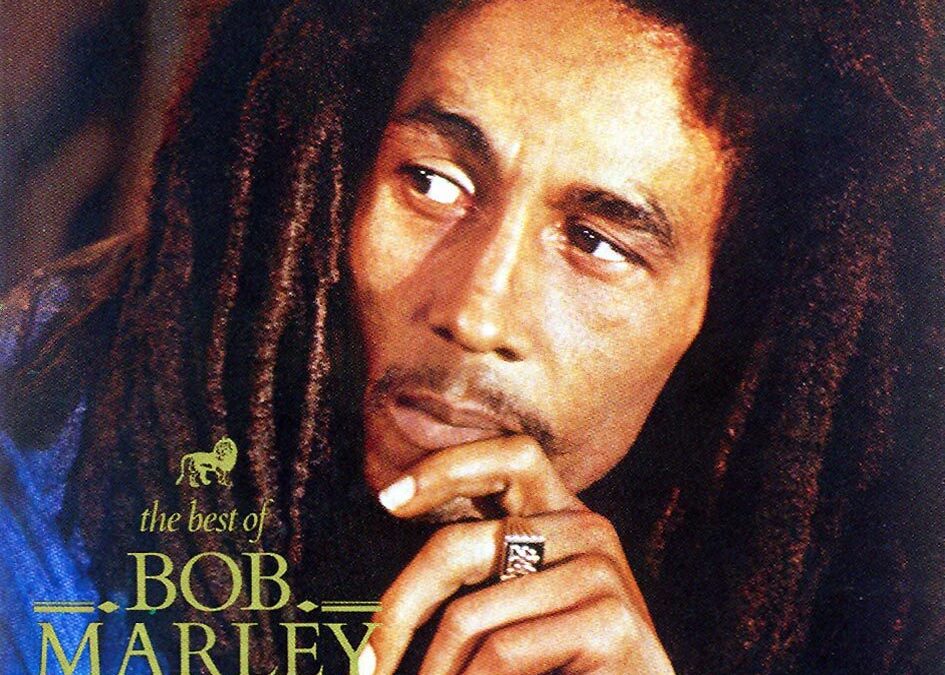
Legend, The Best of Bob Marley and The Wailers / Island Records
Long before he became an icon printed on T-shirts around the world, Bob Marley was a kid from Nine Miles, Jamaica, who recorded his first track, “Judge Not,” in 1962. Two years later, with Bunny Wailer and Peter Tosh, he formed the vocal trio The Wailing Wailers and landed his first Jamaican hit, “Simmer Down.” What followed is a trajectory few artists have matched: a ska musician who became, in under twenty years, the planet’s reggae ambassador, carrying a political and spiritual message that reached far beyond music. Ten songs can’t sum up a body of work this dense, but they trace the essential arc from Trenchtown to the rest of the world.
“Get Up, Stand Up” (1973)
Co-written with Peter Tosh for the album Burnin’, this song was conceived as an anthem of resistance, inspired by a trip Marley took to Haiti, where he was struck by the country’s poverty. It went on to become one of the most widely adopted rallying cries in struggles for civil rights around the world, from apartheid-era South Africa to more recent protest movements. It was also the last song Marley ever performed live, at a concert in Pittsburgh in September 1980, just months before his death.
“I Shot the Sheriff” (1973)
Also from Burnin’, this first-person song tells the story of a man wrongly accused of killing a sheriff. The following year, Eric Clapton’s cover became a U.S. number one, giving Marley a level of international recognition he hadn’t yet achieved as the song’s author. The episode reflects a reality of the time: for a reggae song to reach a mass Western audience, it often took a white artist covering it. Marley kept performing it on stage for years afterward, fully reclaiming it as his own.
“No Woman, No Cry” (1974 / live 1975)
Written for the album Natty Dread, this ballad recalls Marley’s childhood memories of the impoverished Trenchtown neighborhood in Kingston. But it’s the version recorded live at London’s Lyceum Theatre in July 1975, released on the album Live!, that became the definitive one: slower, more lived-in, and Marley’s first real breakthrough outside Jamaica. Often misread as romantic comfort, the song is actually a message of reassurance to a woman who has lost everything but is told not to weep.
“War” (1976)
On the album Rastaman Vibration, Marley set to music, almost word for word, a speech given by Ethiopian Emperor Haile Selassie before the United Nations General Assembly in 1963, on racial and national inequality as the root cause of war. With no conventional chorus, the song plays out as a raw political statement, with no melodic concession. It has since been covered by numerous politically engaged artists, proof that its text has lost none of its force.
“Exodus” (1977)
The album of the same name was recorded in London, where Marley had gone into exile after an assassination attempt in Kingston in December 1976, amid a period of fierce political tension in Jamaica. The title track, running over seven minutes in its album version, draws on the biblical imagery of the Exodus to evoke the symbolic return to Africa central to Rastafari belief. Time magazine would later name the album the greatest record of the 20th century, a late but resounding vindication for a project born out of urgency and exile.
“Jamming” (1977)
Also from Exodus, this track shows the sunniest side of Marley’s catalogue, the side that would go on to shape Western pop for decades to come. Carried by an instantly recognizable bassline, it reached No. 9 on the UK charts. Much of its groove comes down to the band’s rhythm section, Aston “Family Man” Barrett on bass and his brother Carlton on drums, the true backbone of the Wailers’ sound throughout this period.
“One Love / People Get Ready” (1977)
Here Marley borrows the chorus of Curtis Mayfield’s soul classic “People Get Ready” and grafts it onto his own composition, turning it into a call for unity that, much later, became an unofficial anthem for Jamaica at certain national celebrations. The BBC once named it the song of the millennium, a symbolic honor, but a telling one, for a track that lives on far beyond reggae fans.
“Three Little Birds” (1977)
A third gem pulled from Exodus, this nearly childlike singalong (“don’t worry about a thing”) became one of the most universally recognized songs in the entire reggae canon, turning up everywhere from commercials to lullabies. The story goes that three birds would regularly perch near Marley’s Kingston home while he wrote, an anecdote likely embellished over time but one that captures the song’s deliberate lightness, a conscious counterweight to the gravity of “Exodus” or “War.”
“Redemption Song” (1980)
The closing track on Uprising, recorded after Marley already knew he had cancer, this acoustic ballad breaks with everything he’d made before: no reggae rhythm, no band, just his voice and his guitar. The lyrics draw on a speech by Marcus Garvey on mental slavery and call on listeners to free themselves from within. As much a political statement as an artistic one, the song has since passed 300 million streams on Spotify, a figure that says little about its real reach but plenty about its staying power.
“Could You Be Loved” (1980)
The lead single from Uprising, this track opens with one of the most imitated basslines in Marley’s catalogue, closer at times to American disco and funk than to his roots-reggae beginnings. It’s also the song that broke through most widely in the U.S. during his lifetime, confirming his ability to evolve his sound without ever softening his message. It has since passed a billion streams on Spotify, the only song in his catalogue to reach that mark.
Bob Marley died on May 11, 1981, in Miami, at age 36. In less than a decade since his international debut with Catch a Fire, he had already changed the way the world listened to Jamaican music, turning a regional genre into a universal language. The ten songs gathered here barely scratch the surface of a catalogue where every album deserves its own deep dive, but they trace the line running from Trenchtown to the Exodus, from rebellion to peace, without ever losing the thread of an instantly recognizable voice.