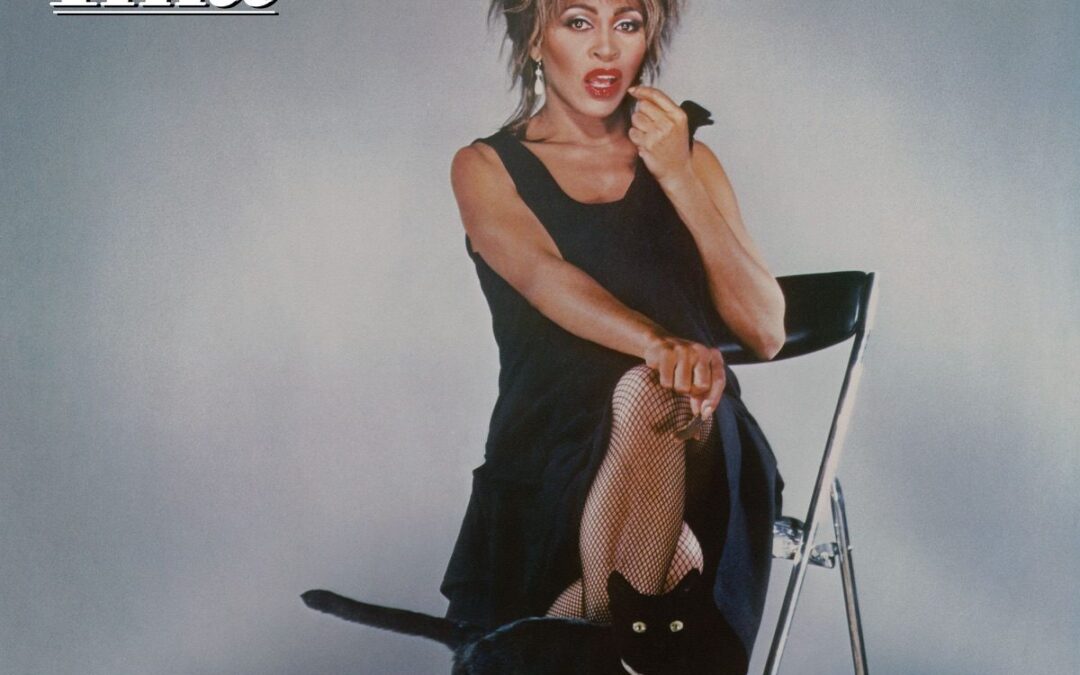
Pochette officielle de l'album « Private Dancer » (1984) — Capitol Records
There’s the voice first: raspy, powerful, able to turn a pop ballad into a cry from the gut. Then there’s a trajectory unlike any other in popular music, from the Ike & Tina Turner Revue of the 1960s to global stardom in the 1980s, by way of a wilderness period she emerged from stronger than ever. Ten songs, taken era by era, trace Tina Turner’s journey, from her beginnings in Tennessee to a James Bond theme that would close out her great pop-rock years.
The Ike & Tina years (1971-1973)
Before the solo star, there were fifteen years as a duo with Ike Turner, her husband and stage partner, who taught her the craft but also kept her under a control she would only break free of by the late 1970s. Two songs are enough to sum up the power of this period.
“Proud Mary” (1971)
A cover of Creedence Clearwater Revival, carried by the Ike & Tina Turner Revue, “Proud Mary” opens gently before flipping, on a now-famous “nice and rough” cue, into a version twice as fast and twice as fierce as the original. That pivot, driven by the Ikettes and a blazing horn section, earned the duo their first Grammy and their biggest entry in the US Top 5. Everything that would become Tina Turner’s signature is already there: a stage energy that belongs to her alone, able to turn any song into a rock’n’roll explosion.
“Nutbush City Limits” (1973)
One of the rare songs Tina Turner wrote herself, “Nutbush City Limits” rides a sharp funk riff to describe the small Tennessee farming town where she grew up: the cotton fields, Sunday church, Saturday-night dances. The duo’s last major hit before Ike and Tina split, the track also got a second life in the 1990s in a more electronic remake, proof it never really left the dancefloor. This is Tina Turner as songwriter, not just performer, laying the groundwork for the artistic independence she would fully claim a decade later.
The comeback (1983-1984)
Split from Ike Turner since 1978, broke and confined to cabaret circuits, Tina Turner had no record deal left by the early 1980s. Within the span of one single and one album, everything changed.
“Let’s Stay Together” (1983)
After years in the wilderness following her split from Ike Turner, it was this cover of Al Green’s soul classic that kicked off Tina Turner’s comeback, first in the UK, where it cracked the Top 10. Produced by Heaven 17 and B.E.F., the version injects synth keyboards and an electro-funk bassline into a song until then tied to classic soul, signalling the pop-rock turn her solo career was about to take. The success, unexpected even to her label, convinced Capitol Records to give her a shot at a full album: “Private Dancer”, a year later.
“What’s Love Got to Do with It” (1984)
Turned down by several other artists before landing with Tina Turner, this song went on to become the biggest hit of her entire career: a US number one, a Grammy for Record of the Year, and a title later lent to the biopic about her life. The video, showing her walking the streets of New York in a leather miniskirt, cemented an image: an independent, desirable 44-year-old woman, far removed from the industry’s usual codes. At 44, she became the oldest woman to top the Billboard Hot 100 as a solo act, a record that stood for decades.
“Better Be Good to Me” (1984)
The second single from “Private Dancer”, “Better Be Good to Me” confirmed Tina Turner’s comeback was no fluke, earning her a Grammy for Best Female Rock Vocal Performance. On stage she performed it in leather from head to toe, a look that would define her for the rest of the decade. The track also illustrates the album’s winning formula: British new-wave pop writers and producers, in service of a voice that came straight out of American rock’n’roll.
“Private Dancer” (1984)
The title track of the album that relaunched her career, “Private Dancer” was originally written by Mark Knopfler for Dire Straits before being handed to Tina Turner. She plays, without ever judging, a cabaret dancer doing her job for the money rather than for pleasure: a first-person narrative rare in her catalogue, carried by a restrained performance that contrasts with the vocal power she’s known for elsewhere. The video, shot at London’s Rivoli Ballroom, was later restored in high definition, proof of how much the song still matters to audiences.
The stadium years (1989)
“Foreign Affair” cemented her as a stadium-touring star across Europe, a status she would keep until retiring from the stage two decades later.
“Steamy Windows” (1989)
Taken from “Foreign Affair”, “Steamy Windows” owes its sultry atmosphere to songwriter Tony Joe White, the master of swamp-rock, who himself plays guitar on several live versions of the track. This is the stadium-touring Tina Turner of the late 1980s, the one filling Europe’s biggest venues with a hard-driving rock band. The song is a reminder that her pop crossover never pulled her far from the blues and rock that shaped her growing up in Tennessee.
“The Best” (1989)
A Bonnie Tyler cover, “The Best” became, in Tina Turner’s voice, a near-universal anthem, still played in sports arenas and at weddings alike. The video’s concept, a simple staging of the singer in concert, reportedly came from Turner herself: no gimmicks needed when the voice carries that far. The song never topped the official charts, but three decades on it remains the track the world most instantly associates with her name.
The last great chapter (1993-1995)
Between the biopic retelling her life and a James Bond theme, the mid-1990s closed out the pop-rock chapter of her career in style.
“I Don’t Wanna Fight” (1993)
Written for the soundtrack of the biopic “What’s Love Got to Do with It”, this ballad marks a change of register in Tina Turner’s catalogue: less muscle, more vulnerability, serving a film that revisits the darkest years of her life with Ike Turner. The video, directed by Peter Care, got heavy rotation on MTV Europe. The song shows that, past 50, the woman telling her own story could also reach audiences on a far more intimate register.
“GoldenEye” (1995)
Commissioned from Bono and The Edge, who wrote both words and music specifically with her voice in mind, “GoldenEye” became the theme for James Bond’s screen comeback with Pierce Brosnan. Tina Turner leans into the orchestral sweep the franchise’s theme songs call for, while keeping the gravelly grain that sets her apart from other 007 vocalists. The video, never officially released beyond the era’s video compilations, shows her in a white gown facing a giant golden eye: one last big-stage moment before her career gradually slowed down in the years that followed.
Ten songs, half a century of music, and one constant: a voice that never sounded like anyone else’s. From the sonic revolt of “Proud Mary” to the sweep of “GoldenEye”, Tina Turner moved through rock, soul, pop and film without ever losing what made her instantly recognisable from the very first notes.