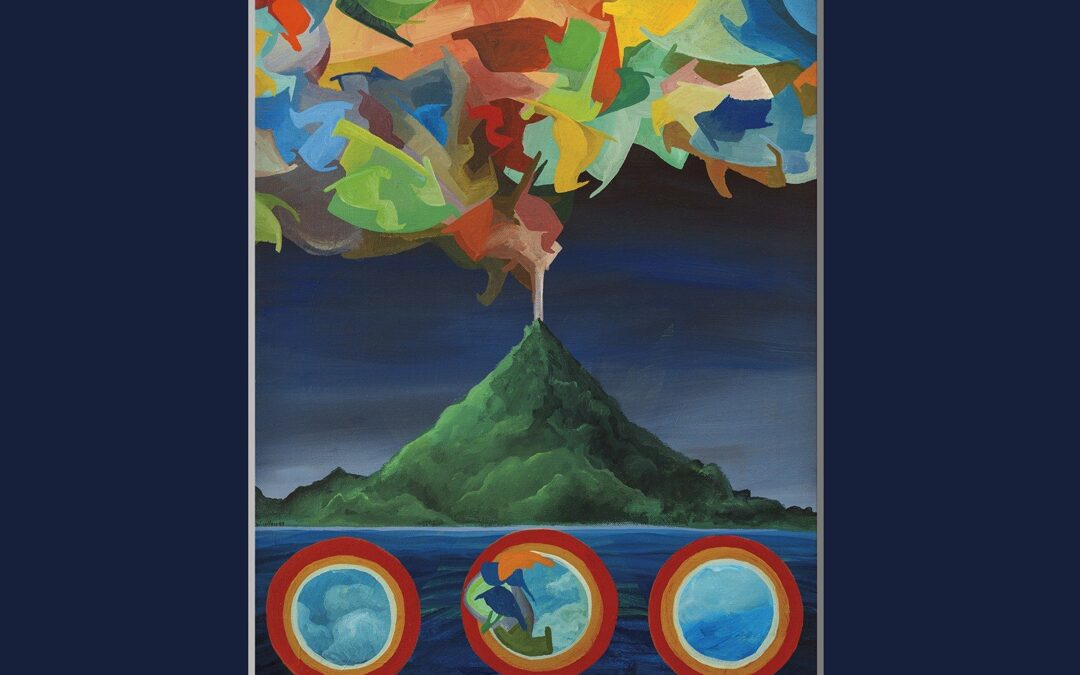
The Same Place — pochette officielle (Elephant 6 Recording Co.)
It took twenty-seven years, two deaths and a painstaking recovery of abandoned tapes for “The Same Place” to see the light of day. The Olivia Tremor Control, a pillar band of the psych-pop Elephant 6 collective alongside Neutral Milk Hotel and of Montreal, returns with a record that plays more like a farewell than a comeback: their final album, out since October 23, closes a chapter that opened in Athens, Georgia, in the mid-1990s.
A record finished by the ones left behind
The Olivia Tremor Control formed around Will Cullen Hart and Bill Doss, two central figures of the Athens psych-pop scene where Elephant 6 first took root before spreading out to Neutral Milk Hotel and Jeff Mangum. The band hadn’t released an album since 1999’s “Black Foliage: Animation Music Volume 1.” Bill Doss died in 2012. Will Cullen Hart, weakened for years by multiple sclerosis, passed away on November 29, 2024 — the very day two unreleased songs, “The Same Place” and “Garden of Light,” came out as singles, like an unfinished message left hanging. It fell to the surviving members, Eric Harris, John Fernandes and Peter Erchick, working closely with producers Derek Almstead, Jason NeSmith and Ron Kwasman, to pick up Hart’s notes and tapes and patiently assemble this sprawling twenty-seven-track double album. This isn’t strictly a posthumous record, then: it’s a work started by several hands and finished by the ones who remained, stitched together from decades of sessions that were never meant to sit on a shelf unheard.
“Garden of Light” opens the record with the band’s signature move: layers of horns, homemade drum-machine patterns and choirs stacking up without ever quite resolving into a single melody. It’s a pivotal song, the one that accompanied the announcement of Hart’s death, and it now carries a weight that its bright, almost naive construction never originally suggested.
A sprawling collection, not a mourning record
The choice of a twenty-seven-track double album wasn’t a studio indulgence. It’s been the Olivia Tremor Control method from the start: pile up fragments, interludes, tape scraps and tightly written pop songs, then let them coexist like a sound collage rather than a straight tracklist. “The Same Place” follows that logic all the way through, and that’s exactly what saves it from pathos. The record doesn’t close in on itself as a funeral tribute; it keeps moving, veering off, still having fun.
“Advice From The Oceans” makes the case best: an almost childlike ode to the sea, carried by horns that sound more like a village brass band than any contemporary psych record. It’s one of the very first songs to emerge from the band’s 2010 reunion sessions, long before the album project had even taken shape — proof that “The Same Place” actually spans close to fifteen years of intermittent work, not just the final months of Hart’s life.
Later in the record’s gestation, “Timewaster” tightens things up: sharper guitars, a more direct rhythm section, like one last burst of energy before the close. Critics have called it a “last opus” within the album itself, and the label fits: the song has the density of a track built to conclude, not simply to fill another slot in an already twenty-seven-entry-long tracklist.
Elephant 6, a utopia that’s still producing
To understand what this comeback means, it helps to remember what Elephant 6 was at its peak: a loose collective born in Ruston, Louisiana, before settling in Athens and Denver, that counted Neutral Milk Hotel, the Apples in Stereo, Beulah and The Music Tapes among its ranks. The Olivia Tremor Control was one of its aesthetic anchors, the band that pushed the collage-pop instinct inherited from “Smile”-era Beach Boys and “Revolver”-era Beatles further than anyone else in the collective. Where Jeff Mangum chose fifteen years of silence after “In the Aeroplane Over the Sea,” Hart and Doss had kept the Elephant 6 machine running, more quietly, right up until their respective deaths.
“The Same Place” is out on double vinyl, a format that suits the project’s scope: twenty-seven tracks, too many for a single LP, not scattered enough to justify a triple. American critics have received this posthumous return warmly; a reviewer at That Love Podcast summed it up as “a beautiful final return,” noting that the record, even while serving as a goodbye, never tries to sand down its edges for the occasion.
Why this record matters
It would be easy to reduce “The Same Place” to its backstory: a cult band, a late founder, an album finished by the survivors. That would miss the point. What makes the record work is that it never reaches for the easy comfort of a posthumous tribute. It extends a precise aesthetic — the one a collective of Athens musicians built in the 1990s, reinventing American psychedelic pop through homemade tape loops and unlikely chamber arrangements — without freezing it into nostalgia. For anyone who’s never heard Elephant 6 before, “The Same Place” is a demanding but generous way in; for longtime listeners, it’s a dignified close to one of American independent rock’s most singular stories. There is no sequel coming after this one, and the band has already said as much, plainly and without ceremony — which makes the album’s refusal to slow down, to tie itself up neatly, feel less like denial than like the most honest way its surviving members could think to send it off.