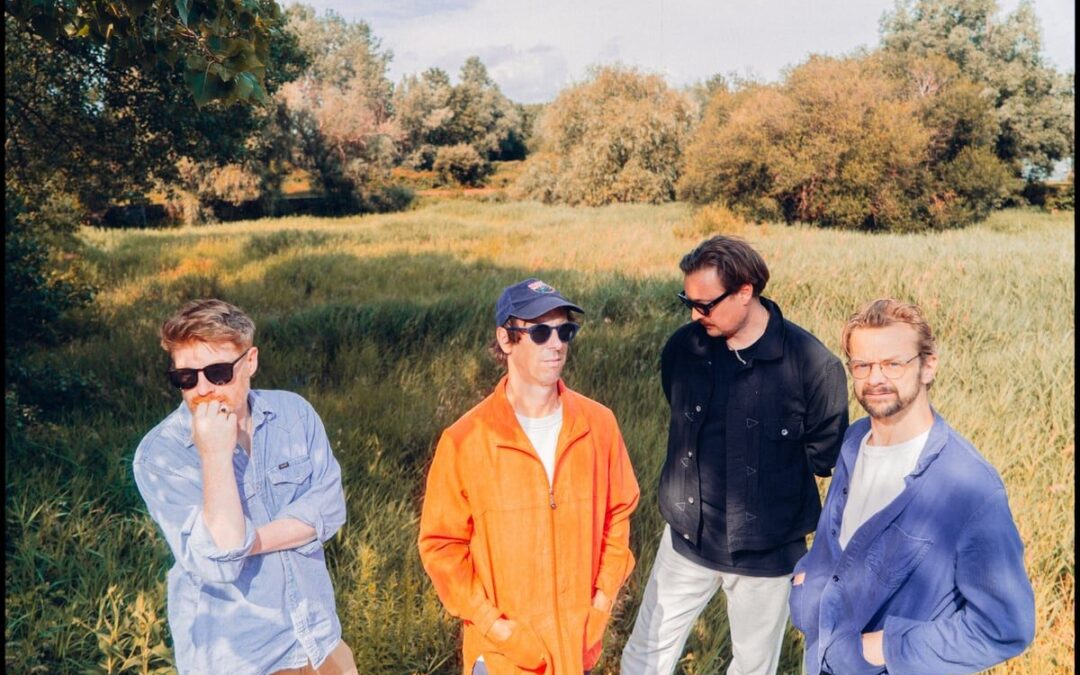
Django Django, photo de presse, juin 2026
Django Django release ‘Doveland’, their sixth album and the band’s first for the German label Clouds Hill. Produced by Nick McCarthy, former Franz Ferdinand guitarist, alongside composer Pollyester, the record takes the opposite path from 2023’s ‘Off Planet’, a sprawling, heavily electronic record built around many collaborations: here, the band returns to a leaner, more organic sound, built around acoustic guitars and more inward-looking songwriting.
Formed in Edinburgh in the late 2000s before relocating to London, Django Django made their name with a widely praised self-titled debut, a mix of psychedelic pop, electronic motifs and layered vocal harmonies that quickly earned them a reputation as a band hard to pin down. Several albums later, the quartet remains true to that identity while evolving it with every record, refusing to repeat the same formula twice — a rare thing for a band that has gone over a decade without any extended hiatus.
A story of grief and disappearance
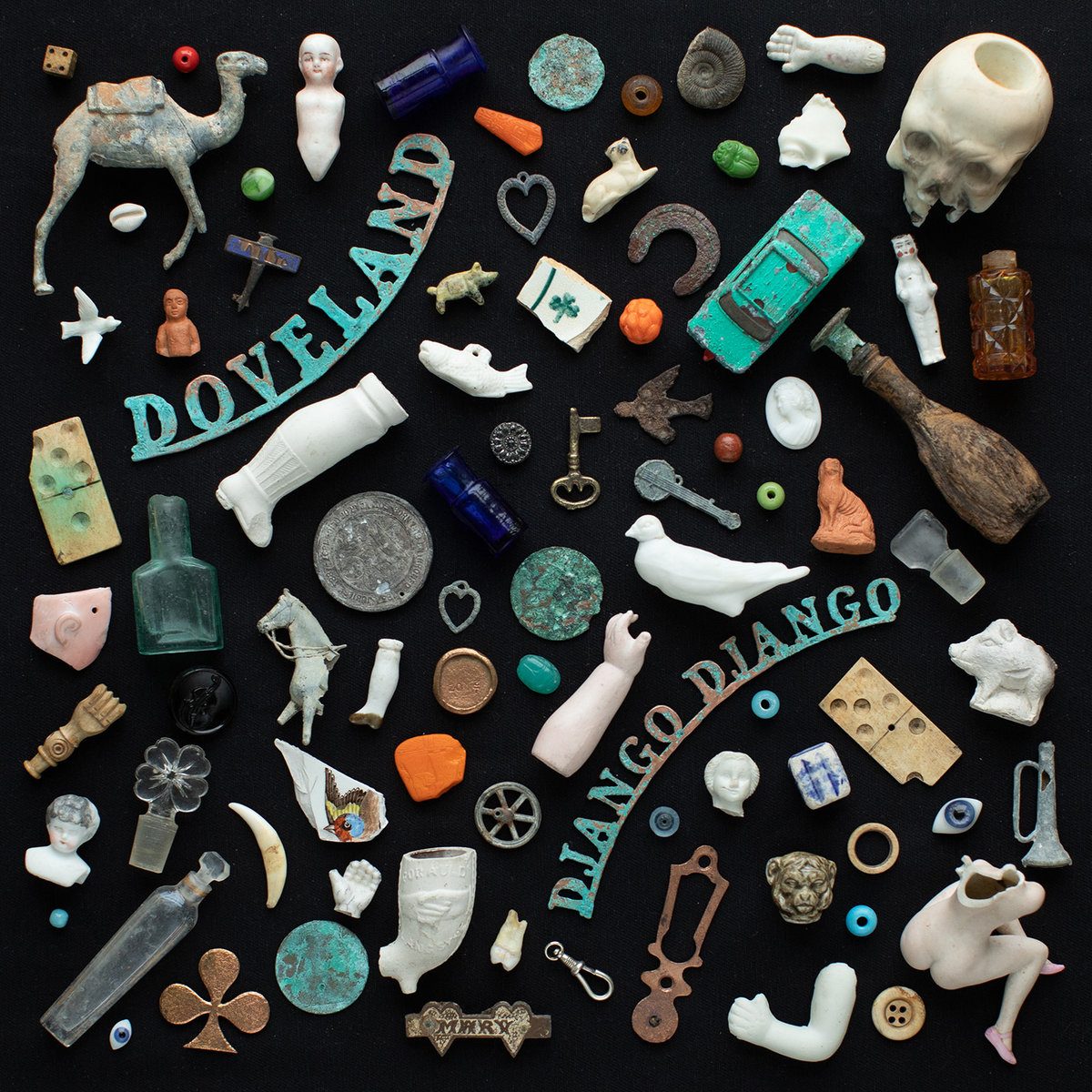
The album’s title comes from an internet urban legend: Doveland, a Midwestern American town that never appeared on any map, yet one that some internet users still claim to remember, going as far as selling fake souvenirs from it online. A fitting image for an album that, according to its creators, is about moving through grief and coming to terms with the fact that some people are only there for part of your story before they too disappear, leaving no more trace than a town that never existed on any map.
That heavier tone is a departure from the sunny, celebratory image usually associated with Django Django since their early days. The band’s frontman has himself described ‘Doveland’ as a more grown-up record, a way of saying the band no longer needs to prove it knows how to throw a party to be taken seriously.
It’s a shift that makes sense for a band now well over a decade into its career, one that has already covered a lot of ground stylistically without ever quite settling into the kind of record built primarily around loss. Framing the album around a myth of a vanished town also gives the band a narrative device loose enough to cover several kinds of absence at once, from a relationship ending to the simple passing of time, without forcing the songwriting into a single literal story.
Cameos, the track that opens the record
The first single revealed from the album, ‘Cameos’ draws on the work of British novelist J.G. Ballard, known for novels exploring the darker undercurrents of modern life and technology. The video, shot in Margate and Deal on the English coast, blends VHS, 35mm film and iPhone footage, with stop-motion sequences built frame by frame by printing and re-scanning each shot — a hands-on process that runs almost against the grain of the digital tools that dominate music video production today.
Dirty Hotel Blues, the album’s second milestone
The second single taken from ‘Doveland’, ‘Dirty Hotel Blues’ continues to explore a nostalgia for things that, deep down, were never quite as good as memory would have us believe. The track captures the direction the band takes on this record well: airier arrangements, more room given to guitars, and songwriting that favours understatement over the instantly catchy hooks that built the band’s reputation in the past.
A few landmarks in the tracklist
The record runs twelve tracks. Among those that can already be named with confidence: ‘Meteorite’, which opens the album, ‘Cameos’ and ‘Dirty Hotel Blues’, the two singles already mentioned, ‘Still Life’, and ‘Little Me’, which features British singer Hak Baker. Another track, ‘Feel Alright’, brings the band together with musician Max Pope. This partial list already hints at the range of tones the band was going for on this record, between more rhythmic tracks and resolutely more introspective ones.
- Meteorite — the album’s opening track.
- Cameos — first single, inspired by J.G. Ballard.
- Still Life — one of the record’s most stripped-back tracks.
- Little Me (feat. Hak Baker) — a duet with the British singer.
- Feel Alright (feat. Max Pope) — a collaboration with the musician.
- Dirty Hotel Blues — second single, about misleading nostalgia.
A more grown-up record, well received by critics
Early reviews of the album have been largely positive, praising a band that pulls off a reinvention without losing what made it distinctive since its late-2000s beginnings: a gift for sun-drenched melodies, now put to the service of a more personal subject matter. Far from a simple stylistic exercise, ‘Doveland’ stands as one of the band’s most accomplished records, and a solid entry point for anyone who only knows Django Django through their most festive hits.
What stands out most on ‘Doveland’ is how the band manages to keep its sonic identity — those instantly recognisable vocal harmonies, that taste for near-hypnotic repeating motifs — while narrowing its focus around more intimate themes than those explored on previous records. Nick McCarthy’s production, itself shaped by his time in Franz Ferdinand, brings a discipline and economy that serve this shift well: fewer stacked electronic layers, more room for each instrument to breathe.
For listeners who mostly know Django Django through their sunniest early-2010s hits, ‘Doveland’ is a good chance to rediscover a band that has, record after record, managed to avoid settling into a fixed formula. It isn’t the most immediate album in their catalogue, but it is arguably one of their most personal, and likely the one that will age best.
To take the measure of the record as a whole, beyond the two singles already discussed, the full album remains the best way in: